
A Practical Approach to Powder Dispensing
Getting the right dose from a volumetric powder dispenser starts with the dosing disk. Volumetric powder dosers use dosing disks with precisely defined chamber volumes. You choose a disk based on the dose volume you need, or on your target dose weight once the powder’s bulk density is taken into account.
This means the same disk can give different dose weights for different powders. One way to deal with this is to calibrate a disk to a specific dose weight for each powder, but that approach has some drawbacks.
Limitations of calibrating a disk to a specific dose weight
Calibrating a disk for a specific powder and dose weight can give accurate results, but it has some practical drawbacks.
First, it takes time and needs enough sample material to run test doses, which isn’t always available early in a project.
Second, powders don’t always behave the same way from one setting to another. Changes in ambient humidity, how the material is handled, and how long it has been exposed to air can all affect how much powder fills the chamber. As a result, a disk calibrated under one set of conditions may give slightly different results in the lab where it is actually used.
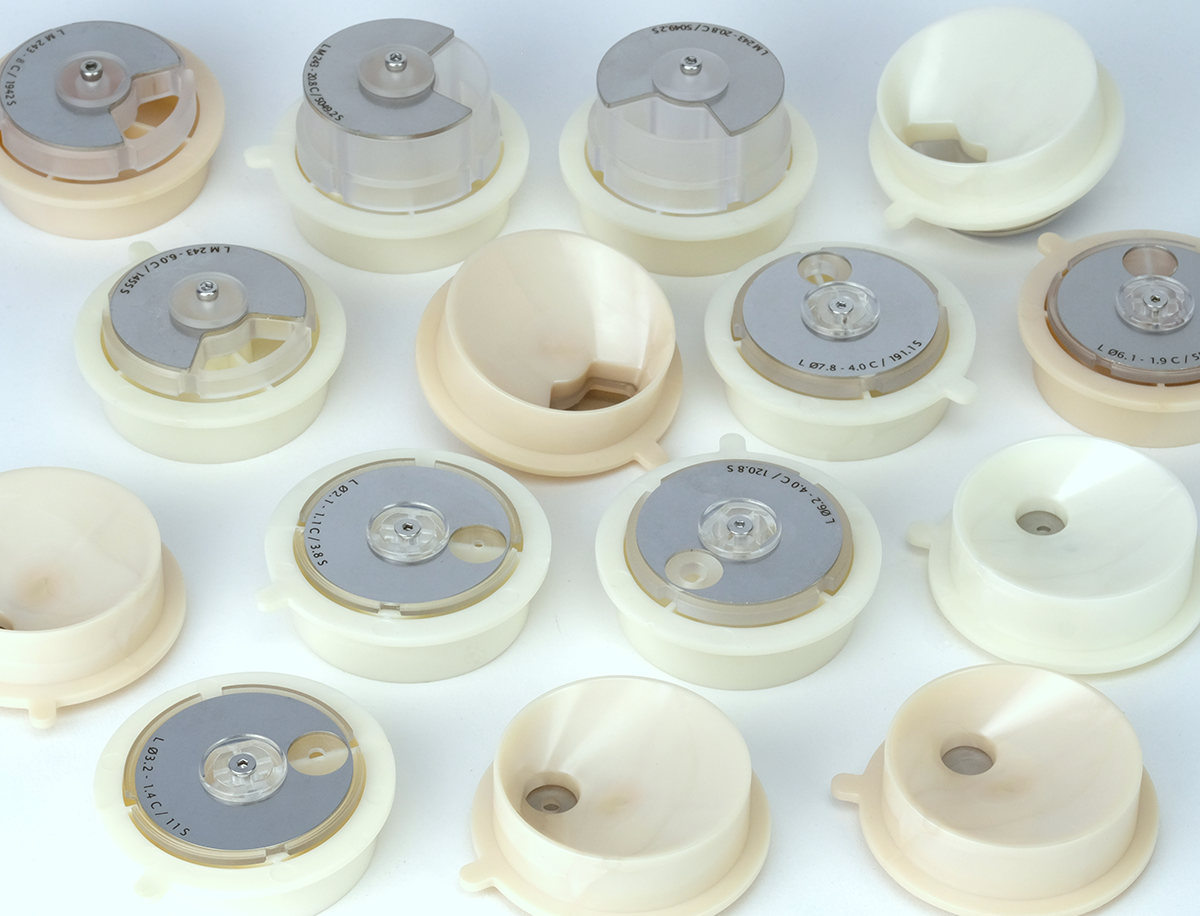
Standard disks offer a simpler starting point.
An alternative is to use a powder dispenser that comes with a range of standard disk sizes. For example, XQ Instruments has significantly expanded the range of standard disk sizes available for its powder dispensers. The dispensers have also been validated with over 200 materials, from glass beads and silica to excipients such as lactose and microcrystalline cellulose. This makes it more likely that one of the standard disks will closely match a given application.
Where necessary, the dose size can be fine-tuned by combining disk selection with multiple dispensing shots.
Adjusting dose size with multiple dispensing shots
If no single disk matches the target dose, the dose can be adjusted by dispensing multiple shots from the same disk. Doses using XQ Instruments’ Powder Dispensers can be set as multiples of the disk’s single dose, up to 99 times. This allows a range of dose sizes from one disk, as long as each target is a multiple of the single dose.

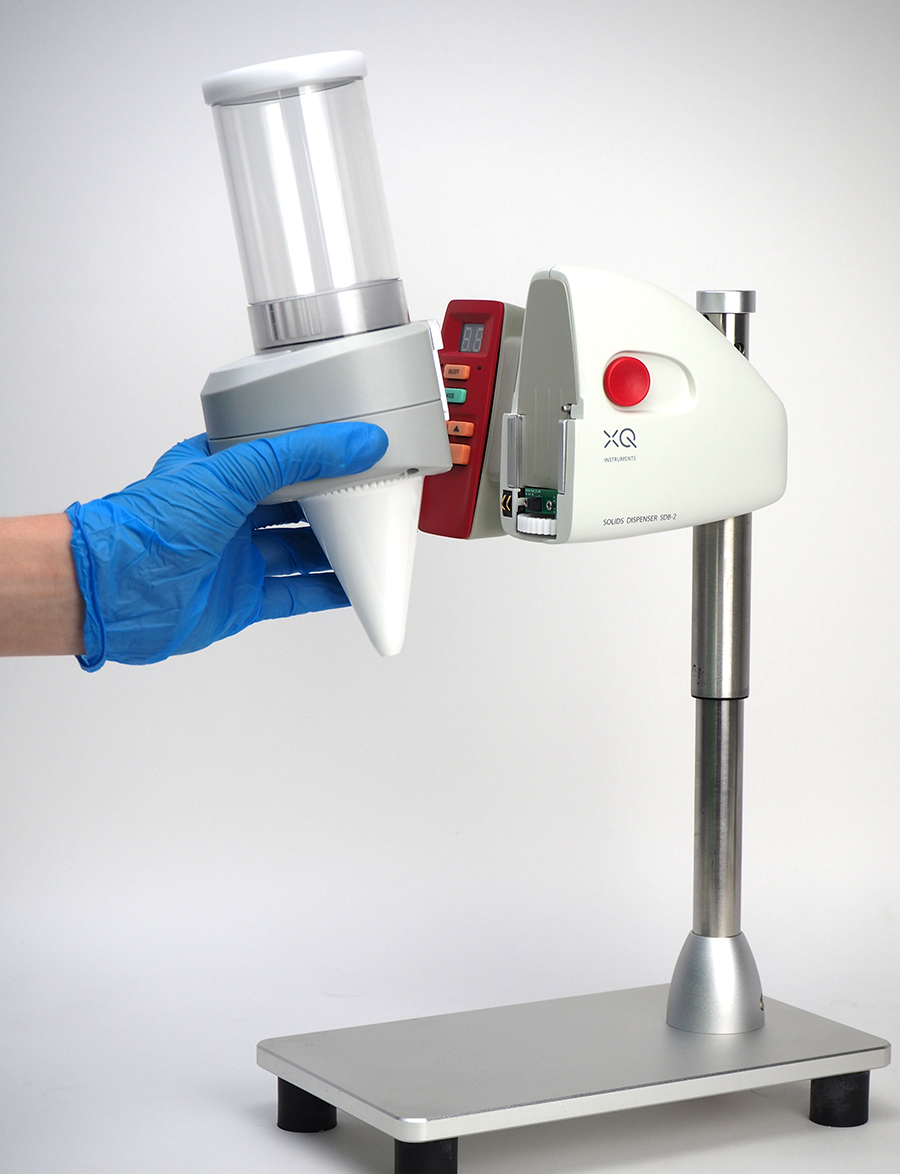
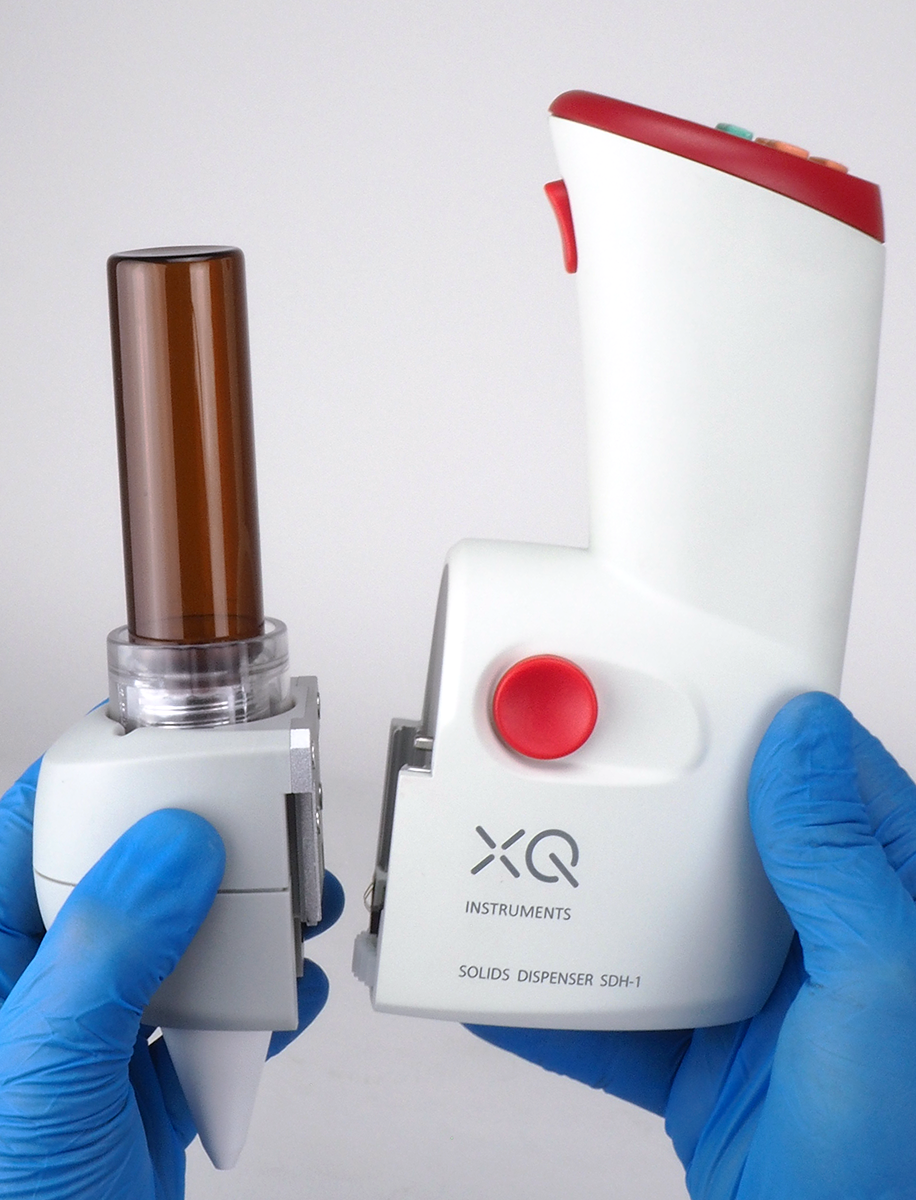
When a custom-calibrated disk is needed
Some applications need tighter agreement with a target dose weight than a standard disk can give. In these cases, a disk can be machined to a specific dose. There are three ways to specify it:
- Target dose volume. This is the most direct option, usually given in mm³.
- Target dose weight and the powder’s nominal bulk density. These are used to calculate the required volume.
- Target dose weight and a sample of the powder. The chamber volume is adjusted until the average of a series of test doses is very close to the target. This gives the best precision.
The last approach can start from trial data on the closest standard disk. In practice, this means beginning with a standard disk, then moving to a custom-calibrated disk only if your accuracy requirements call for it. Additional disks can also be ordered later as dose sizes or materials change.
Disk selection in gravimetric dosing
In gravimetric dosing, the dispenser releases doses until a scale reading reaches the target weight. This applies to XQ Instruments’ SDB-1C and SDB-2C, and to the SDB-1 and SDB-2 when they are integrated with a scale through PC control. Because the scale controls the final dose, exact disk selection matters less than in volumetric mode. Having a range of standard disk sizes still helps balance dispensing speed and accuracy for different dose sizes.
One point to keep in mind is moisture. A gravimetric reading can look consistent even when the powder’s moisture content varies, which means the amount of actual material in each dose may differ. In volumetric dosing, the volume of material stays the same, so this variation shows up when doses are weighed.
FAQ
How do I choose a dosing disk for a given powder?
Use your target dose weight and the powder’s bulk density to estimate the required volume. Then test the standard disks closest to that volume.
Does every powder need its own calibrated disk?
No. A standard disk is often suitable. Custom calibration is an option where tighter accuracy is required.
Can dose size be adjusted without changing disks?
Yes, by dispensing multiples of the disk’s single dose. Single dose size itself can only be changed by swapping the disk.
How accurate is volumetric powder dispensing?
Accuracy depends on dose size and material properties. Larger doses tend to be more consistent. Typical values are around ±3% for common materials and dose sizes.
How small can a dose be?
A typical lower limit is around 2 mg. At very small doses, dosing error increases, and some challenging materials may not dispense consistently.
Why can results vary between calibration and use?
Moisture content, handling and exposure time can all affect how a powder behaves. Very dry environments can also cause issues with powders prone to static.
Should I get additional dispensing disks or additional dispensing heads?
If you change materials or dose sizes only between batches, additional disks are usually enough and more economical. If you switch materials frequently, additional heads let you swap without emptying and cleaning, and avoid cross-contamination.
Does dosing accuracy change over time?
Abrasive materials can wear a disk and affect its dose size. Replacing the disk restores the original performance.
Need higher accuracy?
In most cases, a standard dosing disk is a practical starting point. It is readily available and can often meet your dosing requirements without a dedicated calibration process. If your application needs closer agreement with a target dose weight, a custom-calibrated disk can be produced using trial data from the closest standard disk.
For questions on disk selection or custom calibration, contact XQ Instruments, or see the range of powder dispensers to find out the powder dispenser that fits your needs.
“
Choosing a powder dispensing method starts with understanding the material and the process.
The best solution is one that delivers the consistency you need while meeting the practical demands of your workflow.
At XQ Instruments, we help laboratories find that balance between dose repeatability, speed and flexibility.
Related Articles
No Results Found
The page you requested could not be found. Try refining your search, or use the navigation above to locate the post.
Cultivating Lab Productivity & Occupational Health with Industry Leaders


SUBSCRIBE TO OUR NEWSLETTER
Interested to find out more about XQ Instruments?
Sign up for our newsletter to the latest product updates.
